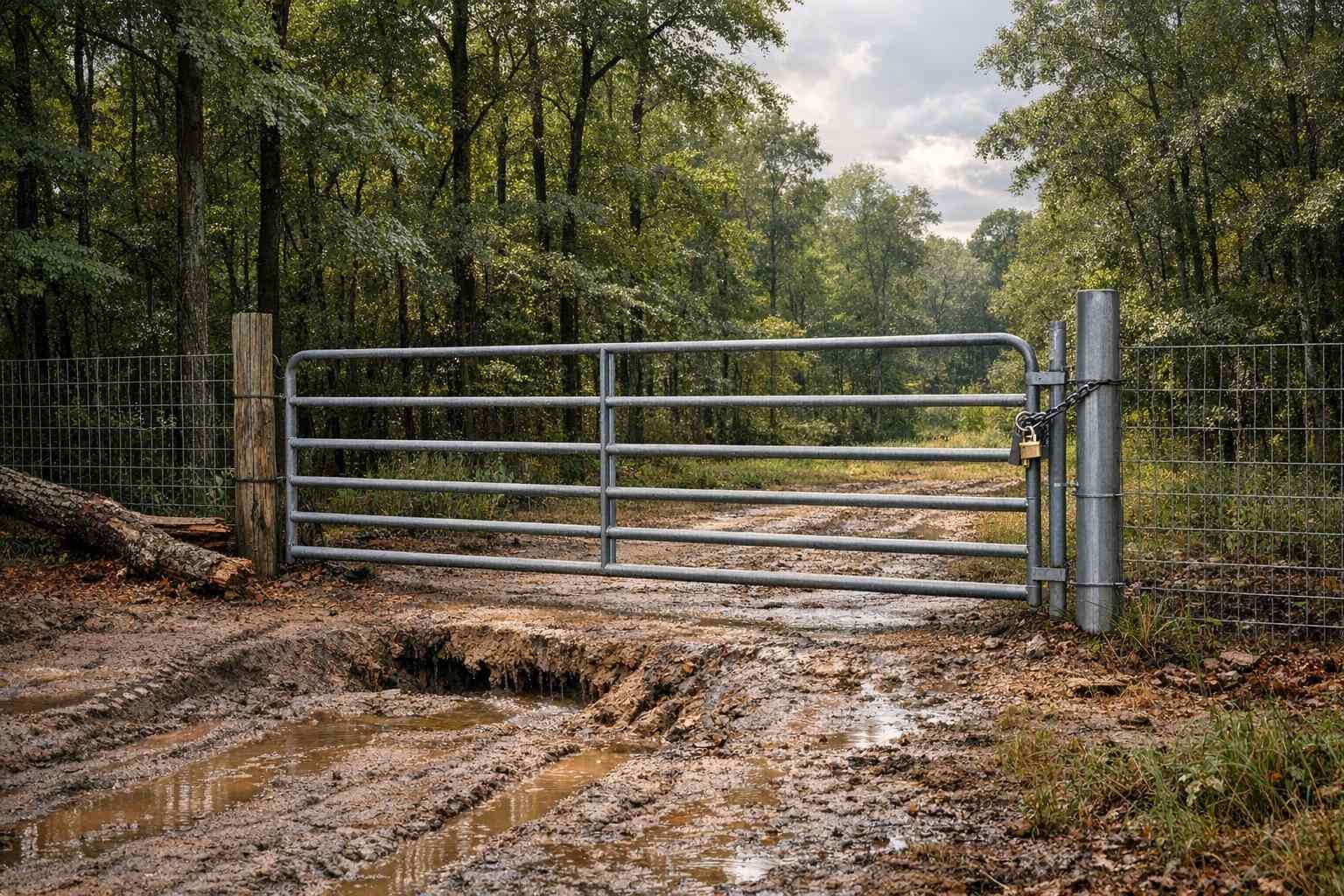
Safely going hunting on leased properties can be a great experience, but properly taking care of the gates and fences is essential to run a smooth operation. We all know how fast a failed gate can ruin a hunting trip for someone, but a failing or broken fence line can cause a lot of problems for many people not just a hunter. Because of this it is very important that landowners and lessees clearly define their respective maintenance responsibilities for things like inspection, repair, access and emergency action before the start of hunting season. The agreement does not have to be lengthy in nature, but rather created to be very specific to that particular piece of property and outline who will be making the decisions. The agreement should clearly lay out the steps of action for a variety of scenarios to promote safe and respectful hunting as well as protect property, livestock and wildlife and foster good relationships with neighbors.
Documenting the Condition of Properties
Maintaining fences and gates has to be more than a general promise. It is best to record the exact condition of the leased areas including all access points. This also includes all the internal gates and the boundary fences as well as all the cattle crossing points. There may be some points that need to be addressed before the lease commences.
The documentation of the initial property condition does not have to be a tedious task and does not have to consist of an extensive survey. Ideally, the date-stamped photographs and annotated maps are accompanied by a few sentences of text to draw attention to specific issues. The reproduction of identical copies and both parties signing off on updated versions of the record over time ensure the necessary transparency. The basic recording requirements must, however, be clearly outlined.
The objective of documenting the initial property condition is to record a fixed point in time. If during negotiations any doubts or ambiguities are discovered concerning boundaries or access rights, it is better to halt agreement for the time being and clarify these issues than rely on memories or old maps.
Selecting the Right Documentation Strategy
Recording maintenance responsibilities can vary depending on individual circumstances. By including details within the main body of the agreement for a smaller property and straightforward access points, owners can ensure that both parties are aware of all issues relating to that property. This method is particularly suited to owner(s) who are actively involved with the property and making decisions regarding it.
More complex scenarios involving a larger area of land, with multiple lessees, agricultural and other recreational activities on the property, would likely require a separate fence maintenance agreement, detailing the map of the property, photolog, maintenance standards, and how approval for work and associated costs are given.
An effective maintenance agreement can also be attached to the end of the main agreement as a maintenance exhibit or schedule. The main agreement can state that maintenance of property will be by one party and then set out the full terms and detail of the required work in the exhibit or schedule.
Distinguishing Between Routine and Major Repairs
Responsibilities need to be clearly set out between property owners and lessees. This should cover routine issues such as shutting gates after using them, reporting broken fence wires, small amounts of debris in paths etc. Major repairs would include issues such as replacing fence posts, re-building a livestock gate, fallen trees etc. Some of these may require the lessee to make urgent repairs to prevent serious loss, but the Lessee should not assume that he has authority to spend in these circumstances and owner must be informed as soon as possible. The approach to dealing with these issues should be clearly set out.
Finding a problem does not automatically give someone permission to repair it. The agreement must set out who is to carry out the various inspections and approve expenditures and obtain supplies. And also who is to contact the repairs people and take urgent action to repair leased property to protect stock and / or property if necessary.
Any arrangement for sharing expenses should be clearly set out. Will there be an allowance to spend or will you split the bill every time. Will approval be needed from the owner before work is carried out or will decisions be made on a case by case basis. These are the sorts of issues that need to be considered and clearly set out.
Ensuring Clear Access Protocols
Responsibility for a gate does not automatically give someone permission to cross neighboring land to reach it. For this reason it is necessary to clearly set out the functional use of the gates on the property and the access rights of the parties. For example, the agreement could clearly set out which gates are the designated entrances to the property and who is responsible for the locks and keys for those gates. The agreement could also specify what type of vehicle is allowed to be brought onto the property and whether notice is required to access certain parts of the property.
For leases held by more than one hunter it will often be sensible to include provision for a coordinator to organize access for all parties. Recording in a simple register or even on a shared communication log who has keys and when gates are opened and closed, and also recording any changes to a fence or gate will be particularly important where livestock, plant equipment or other neighboring properties are involved.
Don't rely on terms and conditions having the same meaning to all. Be sure to capture the 'finer details' within the record, such as whether 'closing' a gate is sufficient to fulfill the fence maintenance responsibility or whether 'locking' or 'latching' is also required.
Adapting to Changing Conditions
Maintenance at a property leased for hunting needs to take account of how the land is used. Storms can wash out access tracks, and fallen trees can block paths or damage fences and gates. The period of the hunting season can coincide with the period of agricultural work and related wildlife management activities of the landowner.
Name primary and backup contacts and agree how to notify them about changes affecting access, repairs, livestock or hunting plans. The parties must also be up to date with the local legislation and seek the advice of legal experts where required.
Agree how the lessee should report fence damage, including damage that could affect wildlife. Do not cut or alter fences to reach a hunting stand without the landowner's permission. Record what authorization is needed before repairs or modifications begin.
Ongoing Review of Conditions
Looking for trouble down the line? Come the start of hunting season, have a chat with your landowner(s) to verify the access points and make sure all relevant contact details are up to date. Try opening and closing all the gates, check that all locks and keys are working as expected. It's surprising how quickly an initially accurate record of a property becomes outdated as the hunting season draws to a close and new developments arise such as additional agricultural activity or modifications to fences and gates.
These are common mistakes made by property owners and lessors. These are the kinds of errors that can lead to negative consequences if not addressed before the start of the hunting season. Remember that it is wise to clearly document all boundaries to a property and record the routes that will be taken to arrive at the best hunting location.
A useful agreement cannot anticipate every problem. It should make the next steps clear: protect people and livestock, notify the right contact, obtain permission where needed, record the work and restore access as agreed.